Strategies
Fires
Floods
Hurricanes
Earthquakes
Others
|
In General
The first thing to do is decide what kind of city you want to build. Once
you know what your long-term goals are, you can best plan your strategy.
If you want to grow your population as large as possible, then zone densely,
keep control of crime, and watch the newspapers for public opinion and important
inventions. If you want to make a lot of money, then tax your subjects until
they scream and keep your spending to a minimum. If you want to create a
city that you'd like to live in, then keep your eye on the newspapers for
public opinion, and mentally put yourself in your Sims' places.
Once you start to build, stay small and go easy on the infrastructure. Keep
your costs down. You want to get out of the red and into the black as soon
as possible. Show a little patience and build up a good reserve of funds.
As you build, try not to make large, densely concentrated areas. The denser
the population of an area, the more pollution and the more crime you have.
Try to find a happy medium between suburban sprawl and super-dense city.
Remember that not only does it cost to build city infrastructure, but it
costs to maintain it.
If you need to skimp on city services, go ahead, but keep your police well-funded.
If your town is small or you have a lot of police stations, you may not
need to keep them fully-funded, but be careful. Use the Query tool to see
your police stations' effectiveness. If the arrests are equal to the crimes,
you can try lowering the funding for a while. Once the arrests fall behind
the crimes, add more funding or more police stations. High crime destroys
land value, chasing out some of your population and lowering your tax income.
Skimping on fire department funding is a little less drastic, but can be
dangerous. Do so at your Sims' risk. You can turn off disasters in the Disasters
menu--if you're a wimp.
Try to maintain high land values to keep those property taxes coming in.
But be sure to zone for some low-cost housing, since all your Sims can't
afford to buy luxury homes on waterfront property.
Remember that you have to replace your power plants every 50 years. Buying
the big expensive power plants is more efficient as far as cost per megawatt,
but only if your city is large enough to need all that power.
You need a good balance of the three basic zones, with the number of tiles
zoned residential approximately equal to the total tiles zoned commercial
and industrial. In a small city, you'll need more industrial than commercial.
You'll need equal numbers of each at a population of about 100,000. Above
that, lean more towards commercial. The Demand Indicator in the City toolbar
lets you know which zones you should be adding.
Try to work with the land instead of using brute force to overpower it.
You'll not only end up with a much more "organic" looking and
feeling city, but it'll save you a lot of money. Best yet, pick or build
a beautiful site for your city before you start to build.
As for the actual layout of your city, maps of cities from all over the
world are easily available. Start with your favorite city and improve on
it.
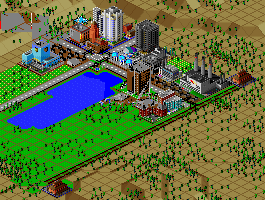 A Small, Balanced City-in-the-Making
Try the modular approach. First try to design a small, compact "neighborhood,"
complete with all the zones, transportation and city services you need,
that runs very efficiently, or better yet, at a profit. Then copy the pattern
of that neighborhood all over the place. Place them strategically so they
can share the high-cost city items like schools, colleges, museums and power
plants.
Above all, use your imagination.
Dealing with Disaster
Unless you have No Disasters set in the Disasters menu, disasters just happen.
If you're the adventurous type (or just plain mean) you can set off your
own disasters from the Disasters menu and test your preparedness, your quick
thinking and the robustness of your city's design. Not all disasters are
available in the Disasters menu. Also, the server machine's player can disable
disasters for all players in the Network Server window.
Certain conditions in your city attract or discourage disasters, and certain
city events can even cause them. So, to a certain extent, you can prepare
for and even lessen the likelihood of disasters.
In the event of a disaster, the first thing to do is stop any fires that
you can. Next, rebuild the utilities, then the transportation system. You
can check your fire coverage in the City Info window. In general, firemen
are good at fighting fires, but can be wiped out by rioters; police are
good at controlling riots, but can get burnt up in a fire. Both fire and
police can handle the manual labor of building dams to help fight floods.
Where a disaster causes destruction in a zone, you must manually bulldoze
the rubble in Demolish/Clear mode before the zone will begin to rebuild.
Fires
Fires are most likely to occur when the weather is hot and you don't have
good fire department coverage. You can bulldoze around a fire zone to try
and prevent its spread.
Floods
Floods occur in the wet season, and can be the byproducts of hurricanes.
They are most likely to occur on the coastline, but occasionally a river
will flood. There's not much you can do once a flood begins, but you can
prepare for the worse. Floods only destroy things at sea level. Your buildings
that are even one tile up will weather the storm. Since seaports must be
at sea level, they are prime targets for flood damage. If you have a river,
try building your seaports upriver, away from the coast. You can also use
the Raise Terrain mode of the Bulldozer tool to build protective dikes in
areas that you think might flood.
Hurricanes
Hurricanes occur because of climatic conditions, and cannot be prevented.
Keep an eye on the weather reports of high winds in the newspaper and you
might receive enough warning to reinforce your police and fire departments
in time. While they are very different in the real world, as far as their
effect in 2KNet goes, they are pretty much the same--hurricanes can really
mess up the place.
Earthquakes
Once again, there's nothing you can do to prevent them. All you can do is
treat the symptoms--and those are many. Earthquakes not only shake down
buildings and damage your city's infrastructure (roads, rails power lines,
etc.), but cause fires, lootings and riots. All you gotta do is put out
the fires, restore power and transportation, control the mobs and rebuild
your city.
Others
There are a number of other disasters that will pop up from time to time
in 2KNet, but you'll find out all about them in your own good time.
|
(C)1996, Maxis, Inc.
|